Halfway to the Stars: The Cable Cars' Long Climb Through a San Francisco Morning
They are moving National Landmarks, the last system of their kind — and on a cold November morning, still the most joyful way to climb a San Francisco hill.
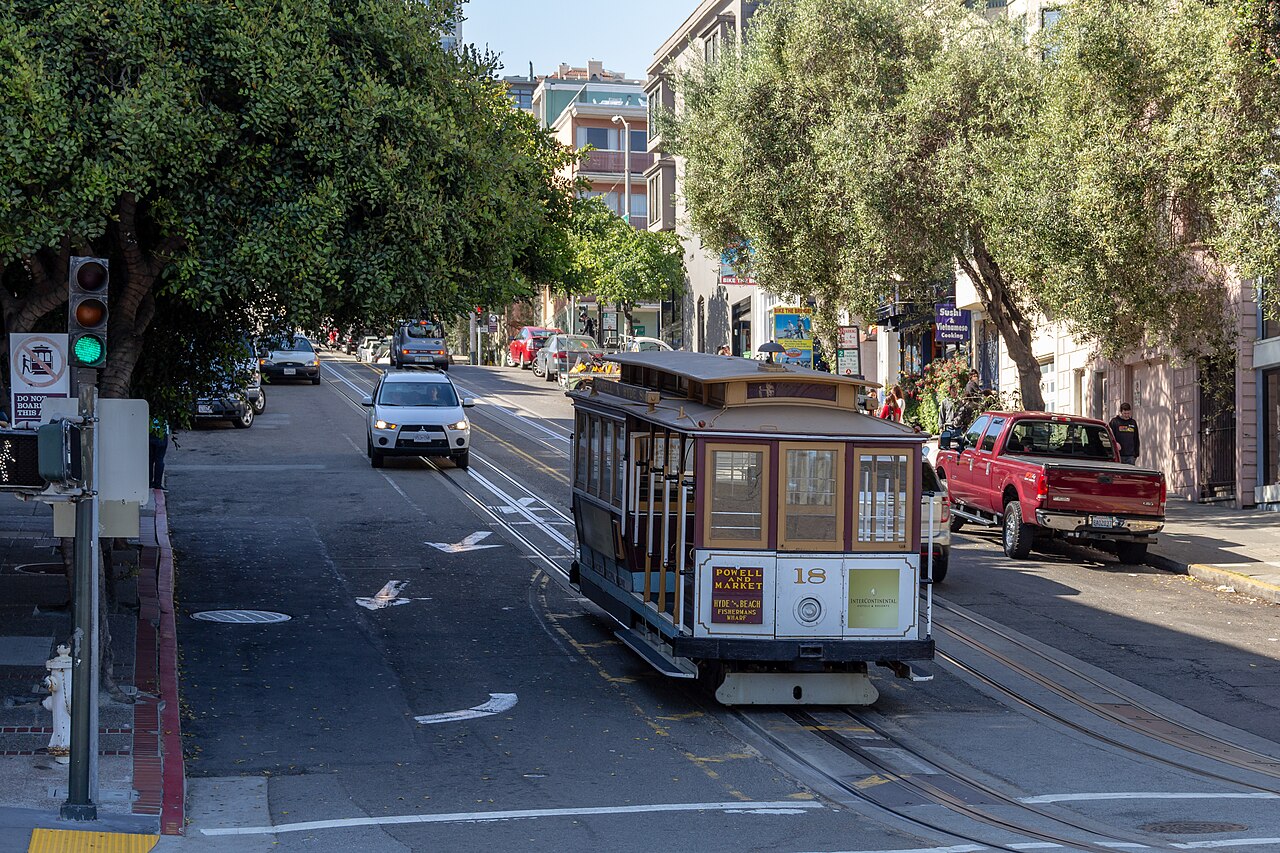
The sound comes first: the clatter of the grip, the bell working in rhythmic bursts, and then a cable car swings into view over the crest of Hyde Street, tourists hanging off the running boards, the gripman leaning into the levers like a sailor into weather. San Francisco's cable cars have been climbing these hills since 1873, and the performance never gets old because it is not a performance. It is transportation, still working.
The system is mechanical poetry. Beneath the street, in a slot between the rails, an endless steel cable runs at a constant speed, hauled by engines in the powerhouse at Washington and Mason. The gripman clamps the car's grip onto the cable to move and releases it to stop — skill, strength and timing substituting for an engine, exactly as designed a century and a half ago.
Three lines remain under Muni's care: the Powell-Hyde and Powell-Mason lines from Powell and Market over the hills to Fisherman's Wharf, and the California Street line climbing from the Financial District through Nob Hill. The cars themselves — some dating to the nineteenth and early twentieth centuries — are maintained by carpenters and mechanics in a craft trade that exists almost nowhere else on Earth.
November mornings are the connoisseur's hour: the summer crowds are gone, the fog or the clear cold comes in off the bay, and a rider can get the outside seat — the one with the view down Hyde Street to Alcatraz, the whole bay opening as the car tops Russian Hill.
Other cities have hills. Only this one answers them with bells. The cable cars are landmarks that move, and every morning they prove the designation is not nostalgia. It is a commute.